A website is no longer an optional marketing asset. In 2026, it functions as the primary digital infrastructure for discovery, credibility, customer acquisition, and long-term growth. Businesses of all sizes, including local companies, startups, service providers, manufacturers, and eCommerce brands, increasingly depend on digital channels to reach customers.
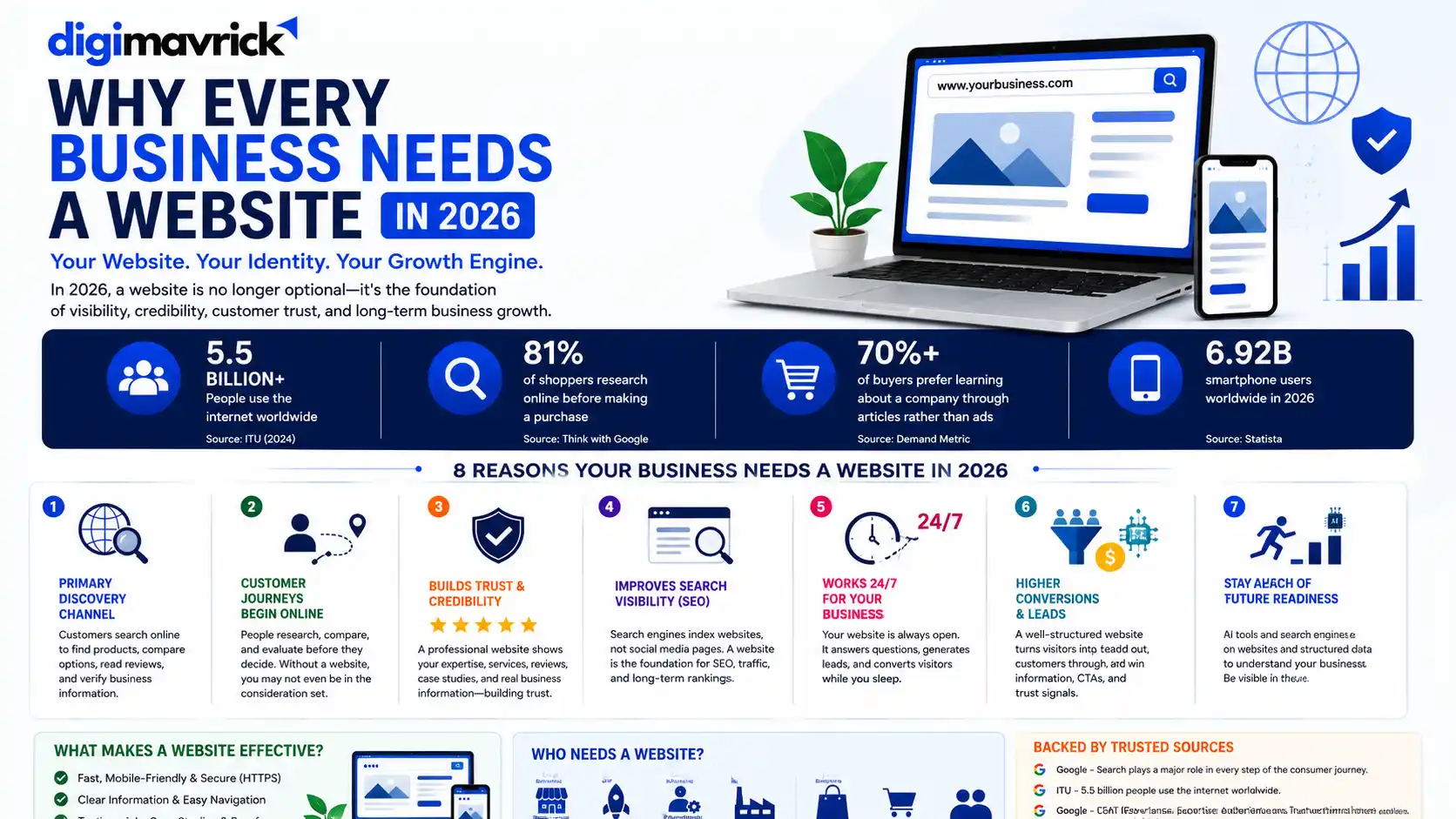
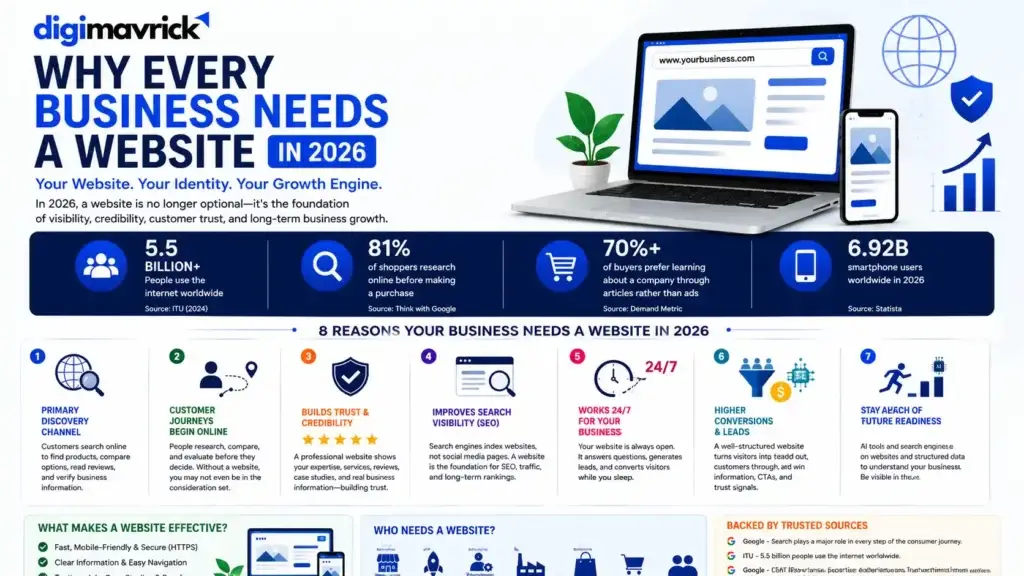
Consumer behavior has shifted significantly over the past decade. Before contacting a business or making a purchase, people commonly search online, compare providers, read reviews, evaluate expertise, and verify legitimacy. Google research shows that search plays a major role throughout purchasing journeys, with consumers using search engines at multiple decision stages. Source: https://www.thinkwithgoogle.com/consumer-insights/consumer-journey/search-purchasing-decisions/
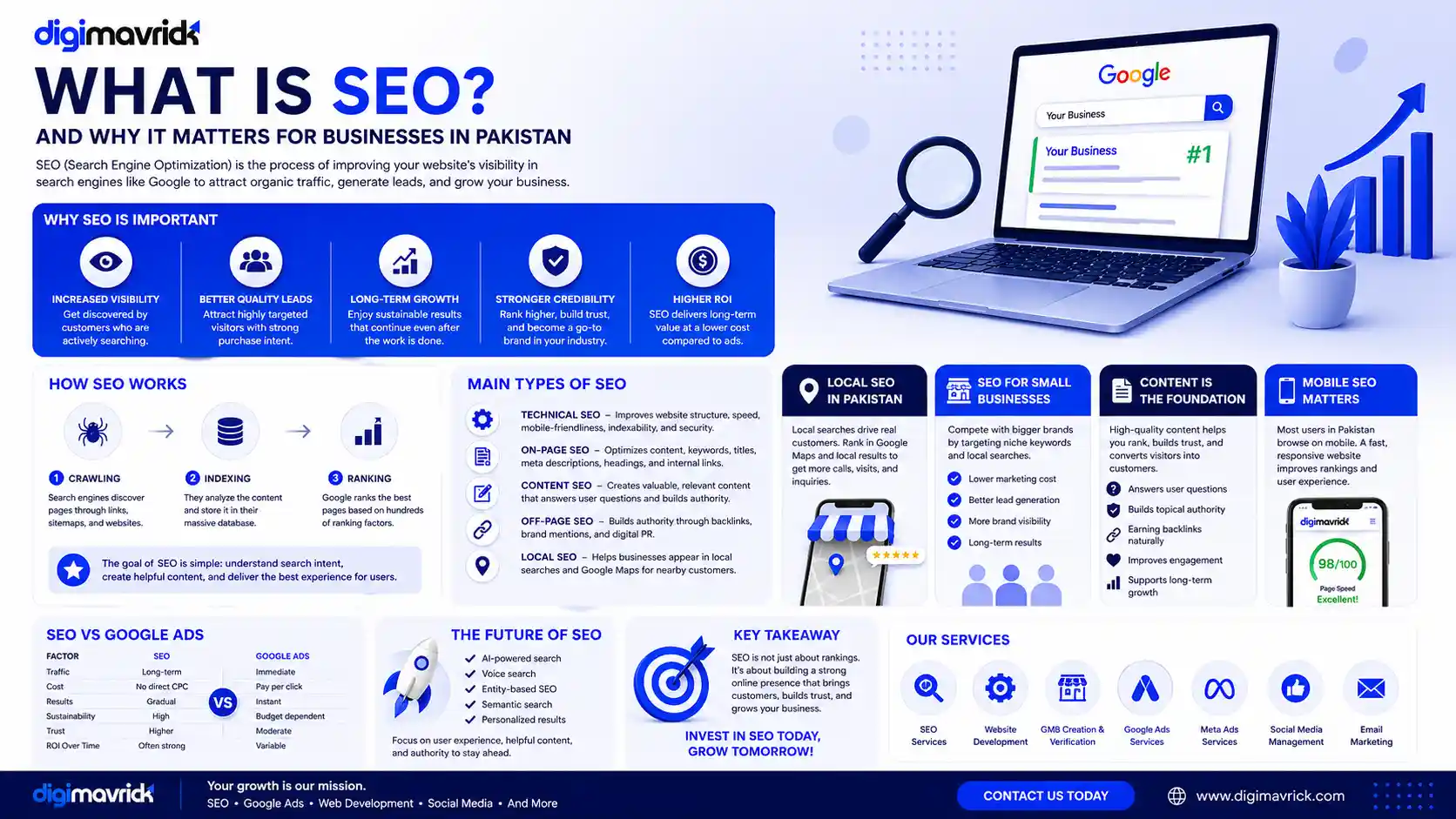
Businesses without a website risk reduced visibility, lower trust, and fewer opportunities to attract potential customers. As discussed in our guide on What Is SEO and Why It Matters for Businesses in Pakistan, search visibility remains one of the most important drivers of business growth. A website acts as the foundation for SEO, content marketing, paid advertising, local search optimization, and customer engagement.
The Internet Has Become the Primary Discovery Channel
The internet has transformed how customers discover businesses. Today, consumers use online platforms to research products, compare services, read reviews, verify business information, check pricing, contact providers, and complete purchases.
This shift is not small. According to the International Telecommunication Union, approximately 5.5 billion people worldwide use the internet. That scale makes digital presence a core business requirement rather than a marketing extra. Source: https://www.itu.int/itu-d/reports/statistics/facts-figures-2024/
Whether a company serves customers locally or internationally, an informative website makes it easier to be discovered. Businesses with accessible, clear, and trustworthy websites are easier to find, easier to evaluate, and easier to trust.
Customer Journeys Begin Online
Modern customer journeys rarely start with a phone call or a store visit. Instead, customers often begin by searching online, comparing options, and verifying credibility.
Google describes a messy middle in which consumers repeatedly explore and evaluate choices before making decisions. During this stage, people frequently search on Google, visit company websites, compare providers, review testimonials, analyze pricing, verify expertise, and read educational content. Source: https://www.thinkwithgoogle.com/consumer-insights/consumer-journey/decoding-decisions-messy-middle/
This behavior applies across industries such as healthcare, real estate, manufacturing, education, legal services, technology, retail, and hospitality. For example, someone searching for SEO services in Pakistan, website development company, Google Ads agency, or local marketing services will often evaluate multiple websites before contacting a provider. Businesses without websites may never participate in those early research stages.
Why Businesses in Pakistan Need Websites More Than Ever
Pakistan’s digital economy is growing quickly as internet access, smartphone usage, and online commerce continue to expand. Customers increasingly search online before purchasing products or hiring services. This is true whether the buyer is in Lahore, Karachi, Islamabad, Faisalabad, Rawalpindi, or any other city.
For businesses in Pakistan, a website helps with visibility, credibility, lead generation, and customer education. It also supports local and national competition, because customers often compare multiple providers before making contact. A website gives businesses a digital presence that works beyond physical location and business hours.
This matters for service businesses, retail stores, agencies, manufacturers, and eCommerce brands. A business that invests in a website is better positioned to compete in search, build trust, and serve a wider market.
A Website Builds Trust and Credibility
Trust influences purchasing decisions. A website helps businesses demonstrate legitimacy and professionalism.
Google’s Search Quality Rater Guidelines emphasize the importance of Experience, Expertise, Authoritativeness, and Trustworthiness. Businesses should use their websites to present accurate, structured, and useful information that helps users understand who they are and what they offer. Source: https://developers.google.com/search/blog/2022/12/google-raters-guidelines-e-e-a-t
Customers often expect businesses to provide company background, services offered, contact information, business location, certifications, case studies, reviews, and team details. When this information is unavailable, potential customers may hesitate to engage. A professional website gives businesses a place to communicate clearly and confidently.
A business can also strengthen trust by publishing privacy policies, terms and conditions, refund policies, and security information. These elements improve transparency and reduce friction in the buying process.
If you need a professional online presence built for trust and conversions, explore our Website Development Services.
Websites Improve Search Visibility
Search engines primarily rely on websites to index and display information. Google Search Central states that websites should be crawlable and indexable to appear in search results. Without a website, businesses cannot fully leverage SEO, organic traffic opportunities decrease, and competitors gain greater exposure. Source: https://developers.google.com/search/docs/fundamentals/seo-starter-guide
SEO helps businesses rank for informational queries, commercial searches, transactional keywords, and local search terms. Organic search remains one of the most sustainable customer acquisition channels because rankings can continue generating traffic over time. A website provides the infrastructure necessary for content creation, keyword targeting, internal linking, technical SEO, and structured data implementation.
To strengthen organic visibility, businesses should treat the website as the core of their SEO strategy. Our SEO Services are designed to help businesses improve rankings, traffic, and lead quality.
A Website Supports Local SEO and Google Business Profiles
Local search has become one of the most important customer acquisition channels for service-based businesses. Consumers frequently search for nearby businesses, compare providers, and read reviews before making contact.
Google states that local search rankings are based on three primary factors: relevance, distance, and prominence. A website directly supports all three factors by helping businesses publish service pages, create location pages, provide accurate contact information, and build local authority. Source: https://support.google.com/business/answer/7091
Google also states that businesses with complete and accurate information are easier for customers to find. That is why a website should work alongside a Google Business Profile rather than replace it. Source: https://support.google.com/business/answer/3038177
For local businesses in Pakistan, a website can support visibility in Google Search, Google Maps, the Local Pack, and branded searches.
If your business depends on local discovery, our Google Business Profile Creation and Verification Services can help strengthen your local search presence.
Businesses Own Their Websites
Social media platforms remain valuable marketing channels, but businesses do not own those platforms. Algorithms change frequently, features evolve, policies may be updated, and accounts can become restricted. A website is different because businesses retain ownership and control over branding, content, user experience, analytics, and lead generation systems.
Google Business Profiles, social media pages, and marketplaces can support visibility, but they should complement a website rather than replace it. Websites provide long-term digital assets that businesses control directly, which makes them more stable and scalable than rented platform space.
Websites Operate Continuously
Unlike physical locations, websites remain accessible around the clock. Customers may browse services early in the morning, late at night, during holidays, or outside business hours. A website can support lead generation, appointment requests, product sales, customer inquiries, and resource downloads continuously.
This nonstop availability allows businesses to serve customers regardless of time zone or operating hours. For companies that work with international clients, it becomes even more important. A website does not sleep, and that is one of its greatest business advantages.
Websites Support Data-Driven Decisions
Modern websites provide valuable data through analytics tools. Businesses can measure visitor behavior, traffic sources, conversion rates, popular pages, user engagement, and device usage. Google Analytics helps organizations understand how visitors interact with websites and where improvements are needed. Source: https://support.google.com/analytics
These insights help businesses improve user experience, optimize campaigns, refine content strategies, and increase conversions. Data-driven decision-making usually produces better marketing outcomes than assumptions. A website gives businesses the ability to learn from real user behavior and adjust accordingly.
Websites Improve Lead Generation
A website can support lead generation by guiding visitors toward specific actions. Examples include contact form submissions, phone calls, quote requests, newsletter signups, and appointment bookings.
Visitors who arrive through search engines often demonstrate existing intent. For example, a person searching for website development services in Pakistan may already be evaluating potential providers. Businesses can create landing pages that align with that intent and improve conversion opportunities.
Effective websites usually include clear calls to action, contact forms, trust indicators, service descriptions, and testimonials. These components help visitors move through the decision-making process more efficiently.
Businesses that want to generate more qualified inquiries can also support their website with Google Ads Services and Meta Ads Services.
Mobile Usage Continues to Grow
Google uses mobile-first indexing, meaning the mobile version of content is primarily used for indexing and ranking. As mobile browsing continues to expand globally, businesses need responsive websites that function effectively across devices. Source: https://developers.google.com/search/docs/crawling-indexing/mobile/mobile-first-indexing
Mobile-friendly websites typically provide faster loading speeds, improved usability, better readability, and easier navigation. Google also uses Core Web Vitals as performance signals that help evaluate user experience. Source: https://web.dev/articles/vitals
Website Speed Matters
Website performance directly affects user satisfaction. Google introduced Core Web Vitals to measure key aspects of page experience, including loading performance, responsiveness, and visual stability. Source: https://web.dev/articles/vitals
The three Core Web Vitals include Largest Contentful Paint, Interaction to Next Paint, and Cumulative Layout Shift. Google recommends optimizing these metrics to improve user experience. Slow websites may experience higher bounce rates, lower engagement, and reduced conversions.
A fast website sends a strong quality signal to both users and search engines.
Website Security Builds Customer Confidence
Website security protects both businesses and customers. Google has encouraged HTTPS adoption for years and treats HTTPS as a ranking signal. Source: https://developers.google.com/search/blog/2014/08/https-as-ranking-signal
Security best practices include SSL certificates, secure hosting, strong passwords, software updates, regular backups, and malware monitoring. Customers increasingly expect businesses to protect personal information. Security contributes to both trust and reliability.
Businesses should also maintain transparent policies such as a Privacy Policy to improve confidence and compliance.
AI Search Is Changing How People Discover Businesses
Search is evolving beyond traditional blue links. AI-powered search experiences now summarize information directly within search interfaces. Examples include Google AI Overviews, ChatGPT Search, Microsoft Copilot, and Perplexity AI.
These systems rely heavily on trustworthy web content. Google states that its ranking systems prioritize helpful, reliable, people-first content. Businesses with structured, authoritative websites are better positioned for visibility in AI-assisted search environments. Source: https://developers.google.com/search/docs/fundamentals/creating-helpful-content
AI systems depend on web content to understand entities, businesses, services, and topics. A website helps establish brand entities, service relationships, industry expertise, and geographic relevance. Without a website, AI systems may have limited information available about a business.
Structured Data Helps Search Engines Understand Websites
Structured data provides machine-readable information about website content. Google explains that structured data helps search engines understand page content and can support eligibility for rich results. Source: https://developers.google.com/search/docs/appearance/structured-data/intro-structured-data
Examples include Organization Schema, LocalBusiness Schema, FAQ Schema, Article Schema, Breadcrumb Schema, and Product Schema. Structured data can help display business details, reviews, FAQs, products, and other useful information in search results. Source: https://developers.google.com/search/docs/appearance/structured-data
For businesses that want to improve semantic clarity, structured data is no longer optional. It is one of the most useful tools for modern SEO and AI search readiness.
Websites Strengthen Content Marketing Strategies
Content marketing depends on websites. Businesses publish content to educate customers, answer questions, demonstrate expertise, support SEO, and generate leads.
Google recommends creating content primarily for people rather than search engines. Valuable content includes industry guides, service explanations, FAQs, research articles, case studies, and tutorials. Source: https://developers.google.com/search/docs/fundamentals/creating-helpful-content
High-quality content can continue generating traffic long after publication, which makes content marketing one of the strongest long-term business assets.
A blog section on your website gives your brand more opportunities to rank for informational and commercial queries while building topical authority in your niche.
Websites Improve Customer Experience
User experience influences how customers interact with businesses online. Google’s Page Experience documentation highlights the importance of user-friendly websites. Source: https://developers.google.com/search/docs/appearance/page-experience
Important user experience factors include fast loading speed, mobile responsiveness, clear navigation, readable content, and accessible design. Websites that reduce friction make it easier for visitors to complete desired actions such as requesting quotes, booking appointments, contacting sales teams, or making purchases.
A strong user experience supports both SEO performance and conversion performance.
Websites Help Businesses Scale
Growth often requires systems that can handle increasing demand. Websites allow businesses to scale operations through online forms, automated booking, eCommerce, customer support resources, and self-service information.
Automation can reduce repetitive tasks while improving efficiency. As businesses expand, a website becomes more valuable because it supports growth without needing to increase physical overhead at the same pace.
Business With a Website vs Business Without a Website
A business with a website has search visibility, SEO opportunities, local SEO support, stronger lead generation, analytics data, AI search readiness, brand control, customer trust, and 24-hour accessibility. A business without a website has limited discoverability, minimal organic reach, reduced local presence, fewer inquiries, limited insights, lower AI visibility, reliance on third-party platforms, reduced credibility, and business-hour limitations.
The difference is not small. In 2026, it is competitive and financial.
Essential Features Every Business Website Needs in 2026
Businesses should prioritize mobile responsiveness, HTTPS security, fast page speed, clear navigation, service pages, contact forms, schema markup, blog functionality, analytics integration, customer testimonials, and conversion-focused design. Google’s Search Essentials emphasize accessible, useful websites that help users accomplish tasks effectively. Source: https://developers.google.com/search/docs/essentials
A business website should not only look professional. It should also function as a lead generation system, a trust-building asset, and a long-term digital property.
Frequently Asked Questions
Do small businesses need a website in 2026?
Yes. A website helps small businesses improve visibility, build trust, and compete in digital marketplaces.
Can social media replace a website?
No. Social media is valuable, but businesses do not control the platform algorithms, policies, or visibility rules.
Does a website help SEO?
Yes. SEO relies on websites for indexing, ranking, and content visibility.
Is a website necessary for local businesses?
Yes. Local customers often search online before contacting businesses.
Does website speed affect SEO?
Google considers page experience and Core Web Vitals among many ranking signals. Faster websites usually deliver better user experience. Source: https://web.dev/articles/vitals
Why is HTTPS important?
HTTPS protects data transmission and supports website security. Google has treated HTTPS as a ranking signal for years. Source: https://developers.google.com/search/blog/2014/08/https-as-ranking-signal
How often should businesses update their websites?
Businesses should regularly update content, security measures, and technical components to maintain performance and relevance.
Does AI search make websites less important?
No. AI systems often rely on web content to understand businesses and topics, so websites remain essential.
What schema markup should businesses implement?
Common schema types include Organization, LocalBusiness, FAQ, Article, and Breadcrumb.
Can websites generate leads?
Yes. Websites can support inquiries, bookings, quote requests, and contact submissions when properly optimized.
Final Thoughts
A website remains one of the most important digital assets a business can own in 2026. Search engines rely on websites to understand businesses. Customers use websites to evaluate credibility. AI systems increasingly depend on structured web content to generate answers. Source: https://developers.google.com/search/docs/fundamentals/creating-helpful-content
Businesses that invest in secure, fast, mobile-friendly websites position themselves for long-term growth. Those without websites risk reduced visibility in search engines, AI search experiences, and local discovery platforms.
Whether the goal is lead generation, eCommerce, local visibility, or brand building, a website provides the platform that supports those objectives.
Ready to build a future-ready online presence? Explore our Website Development Services, SEO Services, Google Ads Services, Meta Ads Services, and Contact Us to grow with a strong digital foundation.