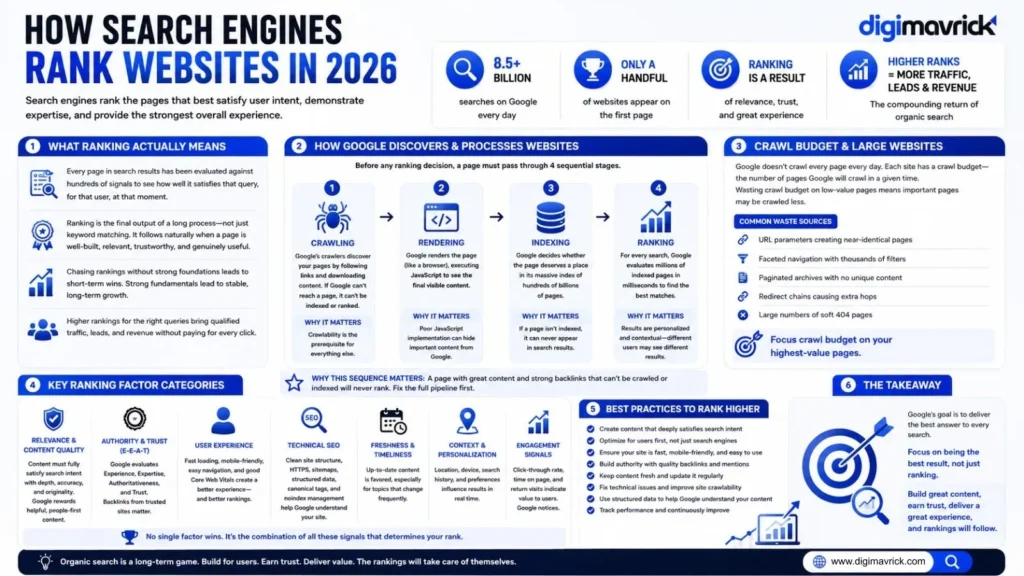
Search engines have not worked the way most people assume they do for a long time. This guide explains, plainly and without shortcuts, exactly how Google finds your website, evaluates it, and decides where it ranks. If you run a business that depends on organic search, this is the foundation you need. More than 8.5 billion searches happen on Google every day, yet only a handful of websites appear on the first page for competitive queries. Why? Because Google doesn’t rank pages simply because they contain the right keywords. It ranks the pages that best satisfy user intent, demonstrate expertise, and provide the strongest overall experience.
What ranking actually means
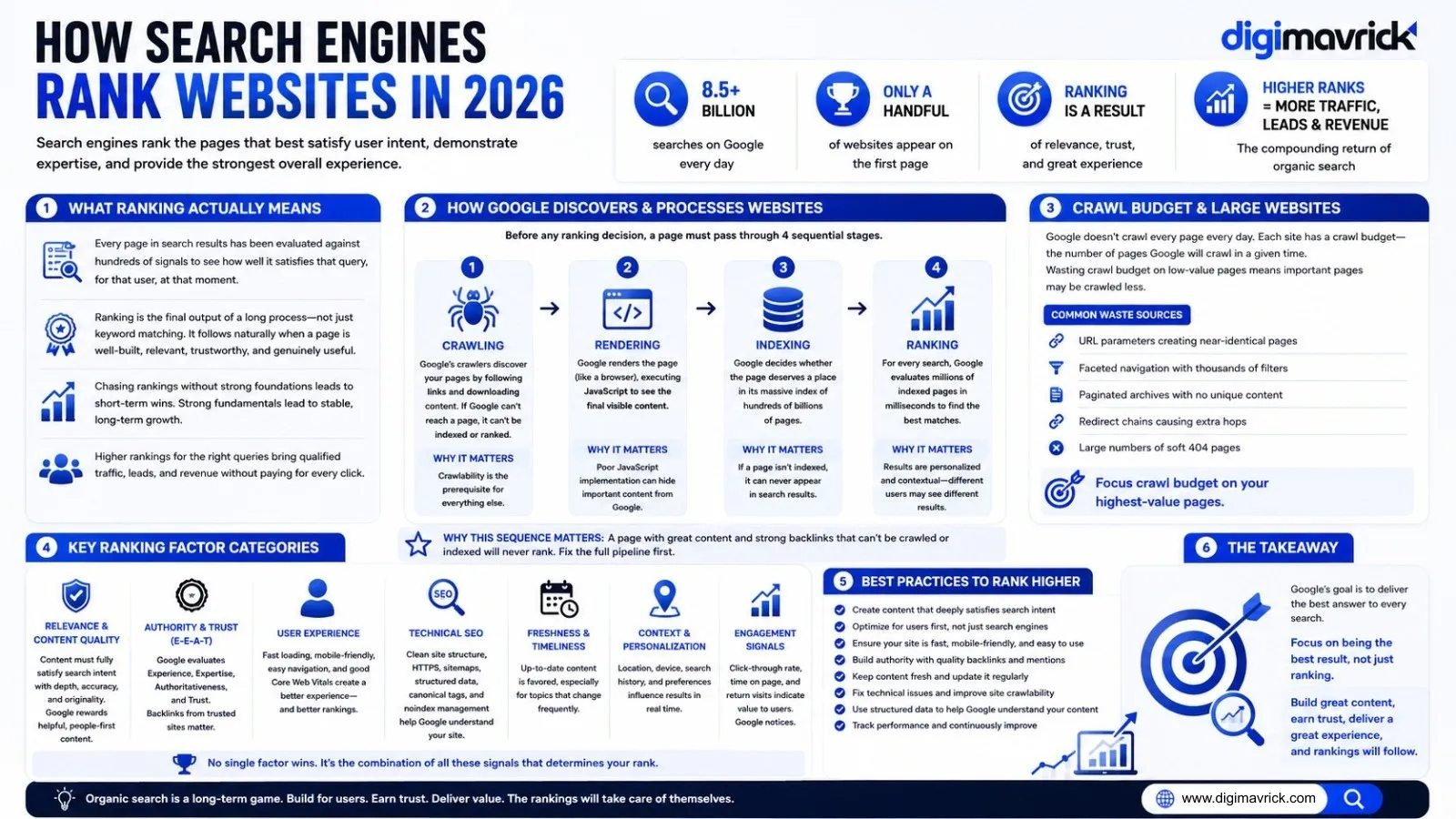
When someone searches a query on Google, the results they see are not random. Every page in those results has been evaluated against hundreds of signals and placed in an order that reflects how well it satisfies that specific search, for that specific user, at that specific moment.
Ranking is the final output of a long, invisible process that starts before your page was ever published. Google has to discover that your page exists, retrieve and process its content, decide whether it belongs in the search index at all, and then determine how it compares to every other eligible page for any given query.
Most businesses think about ranking as a goal in itself. It is more useful to think of it as a result. Ranking follows naturally when a page is well-built, relevant, trustworthy, and genuinely useful. Pages that chase the rank without building those foundations tend to rise and fall unpredictably with algorithm updates. Pages built on strong fundamentals tend to hold their positions.
The higher a page ranks for queries that bring in the right visitors, the more qualified traffic, leads, and revenue it generates without paying for every click. That compounding return over time is what makes organic search one of the most valuable long-term marketing channels available.
How Google discovers and processes websites
Before any ranking decision happens, a page must pass through four sequential stages. Understanding these stages explains why some pages never appear in search results despite being technically well-written, and why others rank within days of being published.
Crawling
Google operates automated programs called crawlers that continuously move across the web, following links from page to page. When a crawler visits your site, it downloads the HTML, CSS, JavaScript, images, and any other accessible resources on the page. It also collects all the links on that page to add to its future crawl queue. If Google cannot reach a page at all, because it is blocked in the robots.txt file, behind a login, or returning a server error, that page cannot be indexed or ranked. Crawlability is the prerequisite for everything else.
Rendering
Modern websites often rely heavily on JavaScript frameworks. After downloading the raw HTML, Google renders the page much like a browser would, executing JavaScript and assembling the final visible page. This matters because content that only appears after JavaScript runs, such as text loaded dynamically or images with lazy loading, may not be seen by Google if the rendering step fails or is delayed. Poor JavaScript implementation is one of the most common reasons important content never gets indexed. Server-side rendering, where the complete HTML is sent from the server before any JavaScript executes, eliminates most of these problems.
Indexing
Once Google has successfully crawled and rendered a page, it evaluates whether the page deserves a place in its search index. The index is an enormous database containing hundreds of billions of pages. Not every page makes it in. Pages with duplicate content, very thin content, missing canonical tags, noindex directives, or serious quality problems are frequently excluded. Being indexed does not guarantee rankings, but failing to be indexed makes ranking impossible. Google Search Console shows which pages are indexed and explains why others have been excluded.
Ranking
When a user performs a search, Google evaluates millions of indexed pages in milliseconds and determines which ones best satisfy the user’s query. This is not a simple keyword match. Multiple machine learning systems analyze relevance, intent, authority, quality, freshness, and dozens of other signals simultaneously before producing the ranked results. The ranking process is also dynamic. Two users searching the same query from different locations, with different search histories, may see different results because Google personalizes and contextualizes results in real time.
Why this sequence matters
Many SEO efforts focus entirely on ranking signals while overlooking crawling and indexing problems. A page with excellent content and strong backlinks that cannot be crawled or indexed will never rank. Diagnose the full pipeline before optimizing individual signals.
Crawl budget and large websites
Google does not crawl every page of every website every day. Each site is allocated a crawl budget, representing how many pages Google will crawl within a given period. For small sites with a few hundred pages, this is rarely a concern. For ecommerce stores with thousands of product variants, news portals publishing hundreds of articles daily, or enterprise sites with complex URL structures, crawl budget management becomes a meaningful optimization challenge.
Common sources of crawl budget waste include URL parameters that generate near-identical pages, faceted navigation creating thousands of filtered category combinations, paginated archive pages with no unique content, redirect chains that force multiple hops before reaching a final URL, and large numbers of soft 404 pages that return a 200 status code but show no real content. Reducing the number of low-value URLs Google needs to crawl allows it to spend more time on pages that actually matter.
Canonicalization
Many websites unintentionally serve the same or very similar content at multiple URLs. HTTP and HTTPS versions, www and non-www variations, tracking parameters, session IDs, and printer-friendly pages can all create duplicate URL problems. Google needs to determine which version is the primary one so it can consolidate ranking signals rather than splitting them across multiple near-identical pages. The canonical tag tells Google which URL to treat as the definitive version. Without it, Google makes its own determination, which may not match what you intend.
The Complete Search Ranking Pipeline: What Happens Before Your Page Appears on Google
Many SEO guides simplify Google’s process into three steps: crawling, indexing, and ranking. While technically correct, that explanation hides the complexity of modern search. In reality, Google processes every webpage through multiple evaluation stages before it becomes eligible to appear in search results.
Understanding this complete pipeline helps explain why some pages rank quickly while others remain invisible despite having good content. Every stage builds upon the previous one. If a page fails early in the process, improvements made later often have little effect.
Stage 1: URL Discovery
Google cannot rank a page it does not know exists.
New URLs are primarily discovered through internal links, XML sitemaps, backlinks from other websites, RSS feeds, and URL submissions in Google Search Console. Internal linking remains the strongest discovery mechanism because it naturally guides Googlebot through the structure of a website.
Orphan pages, which have no internal links pointing to them, are much less likely to be discovered quickly. Even excellent content can remain invisible if nothing connects it to the rest of the website.
Stage 2: Crawl Queue
After discovering a URL, Google decides when it should crawl it.
Not every page is crawled immediately. Google’s scheduling system prioritizes URLs based on several factors, including website authority, historical update frequency, server performance, internal linking strength, and user demand.
Websites that publish consistent, high-quality content often experience faster crawling because Google learns that new pages are likely to contain valuable information.
Stage 3: Crawling
Googlebot downloads every accessible resource required to understand the page.
This includes HTML, CSS, JavaScript, images, videos, structured data, fonts, and linked resources.
During crawling, Google also discovers additional URLs through hyperlinks, continuously expanding its understanding of the web.
If resources are blocked by robots.txt, return server errors, or require authentication, Google may receive only a partial representation of the page.
Stage 4: Rendering
Modern websites rely heavily on JavaScript.
Instead of simply reading raw HTML, Google renders the page using a version of Chrome to see the final experience presented to users.
Rendering allows Google to process:
- Interactive content
- JavaScript-generated text
- Responsive layouts
- Lazy-loaded images
- Dynamic navigation
- Structured data generated after page load
Poor rendering is one of the most common technical SEO issues affecting modern websites. If important content only appears after JavaScript execution and rendering fails, that content may never become searchable.
Stage 5: Content Extraction
Once rendering is complete, Google’s systems begin extracting meaningful information from the page.
Rather than counting keywords, Google’s algorithms identify:
- Main topics
- Supporting concepts
- Named entities
- Products
- Services
- Organizations
- Locations
- Questions and answers
- Media assets
This information helps Google understand what the page actually discusses rather than simply what words appear most frequently.
Stage 6: Entity Recognition
Modern search engines are entity-driven rather than keyword-driven.
Google attempts to identify every important entity referenced throughout the content and understand how those entities relate to one another.
For example, an article discussing SEO may naturally reference Google Search Console, Core Web Vitals, XML Sitemaps, Technical SEO, EEAT, and Structured Data. Google recognizes these as connected concepts within the same topical ecosystem.
Pages that establish clear semantic relationships generally perform better than pages optimized around isolated keywords.
Stage 7: Canonical Selection
Many websites unintentionally create multiple URLs displaying nearly identical content.
Examples include:
- HTTP and HTTPS versions
- WWW and non-WWW versions
- Tracking parameters
- Session IDs
- Category variations
- Printer-friendly pages
Google determines which version should become the primary URL.
Proper canonical tags help consolidate ranking signals into one authoritative page instead of dividing authority across duplicates.
Stage 8: Quality Evaluation
Before adding a page to its search index, Google evaluates its overall quality.
This assessment considers numerous signals, including:
- Originality
- Accuracy
- Expertise
- Helpfulness
- Readability
- Technical quality
- Spam indicators
- Trust signals
- User experience
Pages that appear automatically generated, duplicate existing information, or provide little value may never enter the index.
Stage 9: Index Selection
Only after passing Google’s quality evaluation does a page become eligible for indexing.
Google’s index contains hundreds of billions of webpages, but not every crawled page is included.
Reasons pages may remain excluded include:
- Duplicate content
- Thin content
- Soft 404 responses
- Canonical conflicts
- Noindex directives
- Low perceived value
Being indexed simply means a page is eligible to compete in search results. It does not guarantee visibility.
Stage 10: Candidate Retrieval
When someone performs a search, Google does not compare every indexed page on the internet.
Instead, it retrieves a much smaller collection of candidate pages considered potentially relevant to the query.
Candidate selection depends on semantic relevance, entity matching, topical authority, historical quality, freshness, language, and numerous contextual signals.
Only these candidate pages proceed to the ranking stage.
Stage 11: Ranking Systems
Google then evaluates candidate pages using multiple machine learning systems simultaneously.
Rather than relying on one algorithm, different systems analyze different aspects of quality.
These systems evaluate factors such as:
- Search intent
- Content quality
- EEAT
- Backlinks
- Internal linking
- Core Web Vitals
- Mobile usability
- Structured data
- Freshness
- Brand authority
Each system contributes to Google’s overall confidence that a page deserves to appear for a particular search.
Stage 12: Re-ranking and Search Features
The final rankings are not always the final presentation.
Additional systems determine whether pages qualify for enhanced search features, including:
- AI Overviews
- Featured Snippets
- People Also Ask
- Local Pack
- Knowledge Panels
- Image Results
- Video Results
- Shopping Listings
This means ranking first organically does not always mean appearing first visually on the search results page.
Why Understanding the Pipeline Matters
Many SEO campaigns focus exclusively on improving rankings while overlooking earlier stages of Google’s evaluation process.
A page with outstanding content, strong backlinks, and excellent user experience still cannot rank if Google cannot discover it, crawl it efficiently, render it correctly, or determine that it deserves inclusion in the index.
Successful SEO is not about optimizing a single ranking factor. It is about removing friction at every stage of Google’s processing pipeline so the best possible version of your content can compete in search.
How Google understands search queries
Google stopped matching keywords literally years ago. It now tries to understand the meaning behind a query rather than the words within it. When someone searches “how to fix a slow laptop,” Google does not look for pages that contain those exact words. It identifies what the user is experiencing, what outcome they want, and what kind of content would actually help them achieve it.
This understanding is built on several dimensions working together. Google considers the user’s likely intent based on the words and phrasing chosen. It factors in context, including location, language, and previous searches within the same session. It identifies entities, which are specific recognizable things like businesses, products, locations, and people, and uses the relationships between those entities to clarify meaning. For a query like “apple store hours,” it understands that apple refers to Apple Inc. and not the fruit, and that the user is looking for opening times for a physical location near them.
This matters for how you write and structure content. Pages that naturally cover the full semantic territory of a subject, using the vocabulary a knowledgeable person would use without artificially repeating target phrases, tend to perform better than pages that have been optimized to hit a keyword a specific number of times.
Search intent: the first gate every page must pass
Search intent is the underlying goal a user has when they type a query. It is the most important ranking signal in 2026 and the one that determines whether all other optimization efforts will pay off or not. A technically perfect page that does not match the intent behind the query it targets will not rank, regardless of its other strengths.
Google categorizes intent into four broad types, and each type requires a different kind of page.
Informational
The user wants to learn something.
Example: “how does HTTPS work”
Commercial
The user is comparing options before deciding.
Example: “best SEO tools for small business”
Transactional
The user is ready to take an action or make a purchase.
Example: “hire SEO consultant Pakistan”
Navigational
The user wants a specific website or page.
Example: “Google Search Console login”
The format of the content must match the intent. Informational queries are satisfied by guides, explanations, and educational articles. Commercial queries need comparison pages, reviews, or feature breakdowns. Transactional queries call for service pages, product pages, and clear calls to action. A service page competing for an informational query, or an educational article targeting a transactional query, will not rank because the format does not satisfy what the user came for.
The simplest way to verify intent before writing any page is to search the target query yourself and look at the top three results. Notice whether they are articles or product pages, long or short, structured as guides or lists or comparisons. That format is what Google has determined, based on how millions of users have responded to results, best satisfies that intent. It is the format you need to match.
Intent alignment is a prerequisite. Every other ranking factor assumes you have already got this right.
The ranking signals that matter most in 2026
Google evaluates pages across hundreds of signals. The following are the ones with the strongest influence on where pages appear in search results. None of these works in isolation. They compound each other.
| Signal | What Google is measuring | Weight |
| Search intent match Core | Does the page’s format, depth, and purpose align with what the user actually wanted when they ran the query? | Foundational |
| Content quality Core | Is the content genuinely helpful, accurate, original, and more useful than competing pages for this query? | Very high |
| EEAT signals Core | Does the page demonstrate real experience, expertise, authority, and trustworthiness in its subject area? | Very high |
| Topical authority Core | Does the site demonstrate comprehensive, interconnected expertise across the subject area, not just one isolated page? | High |
| Backlinks Strong | Are authoritative, relevant websites in the same or adjacent industries linking to this page editorially? | High |
| Core Web Vitals Strong | Does the page load quickly, respond to user input without delay, and maintain visual stability while loading? | Moderate to high |
| Mobile experience Strong | Is the page fully functional and readable on mobile devices? Google indexes the mobile version first. | Moderate to high |
| Internal linking Strong | Are related pages on the site connected logically, helping both users and crawlers navigate the content structure? | Moderate |
| Structured data Growing | Does the markup help Google understand exactly what type of content the page contains and what entities it discusses? | Moderate, growing |
| Brand signals Growing | Do users search for the brand by name? Is the entity referenced and cited across the web beyond its own site? | Moderate, growing |
| Content freshness | For topics where information changes regularly, is the page kept current with accurate, updated information? | Query-dependent |
What content quality actually means
Google’s Helpful Content System, introduced and expanded over the past several years, is built around one central question: was this page created to help people, or was it created to rank? The distinction sounds simple. In practice, it separates the majority of content on the web from the fraction that consistently earns strong organic visibility.
High-quality content answers the user’s question completely and directly, without burying the answer under unnecessary preamble. A user who searches a specific question and has to scroll through three paragraphs of general background before reaching the information they came for has had a poor experience. That kind of page performs worse over time as behavioral signals accumulate.
Quality also means accuracy. A page that contains factual errors, outdated information, or claims that cannot be verified sends negative signals whether or not Google’s systems catch the specific error. Users who discover inaccuracies leave quickly, and that pattern shows up in the behavioral data Google uses to calibrate its quality assessments.
Comprehensiveness matters. A page that answers the primary question and also addresses the natural follow-up questions a reader would have provides a significantly better experience than one that answers only the minimum. This does not mean padding content with unnecessary filler. It means thinking through what a person who does not yet know the answer genuinely needs to know, and providing that in a logical order.
Readability is not a separate consideration from quality. It is part of it. Content that is well-organized with clear headings, written in plain language appropriate for its audience, and structured so the reader can navigate to the section most relevant to them is simply more useful than content that reads as a wall of text. Google increasingly uses signals like time on page, scroll depth, and return visits as proxies for whether the reading experience was satisfying.
Finally, originality. Generic content that restates what other articles already say adds nothing. Google can assess whether a piece of content introduces any new perspective, data, framework, or analysis. Content that does not clear this bar struggles to rank against content that does, regardless of keyword optimization.
Information gain and why it separates strong content from weak
Information gain is a concept Google uses to measure the unique value a piece of content contributes beyond what already exists in the search index. As AI-assisted writing tools have made it easier to produce large volumes of plausible-sounding content quickly, Google has intensified its focus on whether content actually adds something to the conversation rather than restating it in slightly different words.
A page has high information gain if it contains something that a user could not get from reading the existing top results. That something does not have to be groundbreaking. It can be a specific dataset, a framework built from real client experience, a comparison drawn from hands-on testing, a case study from actual implementation, or an expert perspective that reflects genuine depth of knowledge rather than surface-level summary.
A page has low information gain if it is essentially a synthesis of what other pages already say, dressed in different words. This includes the large majority of AI-generated content that has no human experience or proprietary data behind it. This content may read fluently and pass a basic quality check, but it does not add anything that helps a user understand the subject better than they could by reading what is already available. Over time, Google deprioritizes it.
Practical implication
Before writing any new piece of content, spend fifteen minutes reading the top five results for the target query. Make a list of what they cover. Then identify what you can say that none of them do. That gap is where the article should focus its energy. If you cannot identify a meaningful gap, either find a different angle or choose a different topic.
For agencies and B2B businesses, information gain often comes from client data and real implementation outcomes. An article titled “How to improve Core Web Vitals” competes against thousands of similar guides. An article titled “What we learned improving Core Web Vitals across 30 ecommerce sites” has something specific and demonstrable to offer. The specificity is the value.
Topical authority and how Google evaluates entire websites
Google does not evaluate pages in isolation. It evaluates them in the context of the website they belong to. A single excellent article about SEO does not establish a website as an authority on SEO. A website that covers SEO comprehensively across dozens of interconnected, well-written pages does.
This is what topical authority means. It is the degree to which Google’s systems determine that a website has genuine, demonstrated expertise across a subject area, based on the breadth, depth, and quality of its content coverage. A site with strong topical authority ranks more easily for new content in that area because its existing body of work has already established credibility.
Building topical authority requires a deliberate content strategy rather than opportunistic publishing. Each piece of content should cover a meaningful aspect of the subject that is not already covered elsewhere on the site. Topics should connect to each other through logical internal links. Together, the content should map the full territory of the subject so that a user interested in any aspect of it can find what they need without leaving the site.
For an SEO agency, topical authority in SEO means having strong, well-linked content covering technical SEO, on-page optimization, link building, local SEO, ecommerce SEO, keyword research, search intent, Core Web Vitals, semantic SEO, structured data, AI search, content strategy, and related topics. A site that covers all of these areas with genuine depth is positioned differently in Google’s evaluation than a site that publishes occasional articles on a few of them.
The practical implication is that adding more content does not automatically build topical authority. Adding the right content in the right structure, connected intelligently to existing pages, does. Publishing fifty thin articles in the hope that volume signals expertise is the opposite of what Google is looking for.
Technical SEO: the foundation everything else depends on
Technical SEO refers to the set of practices that ensure Google can efficiently discover, crawl, render, and index a website’s pages. It is not a separate activity from content or authority building. It is the infrastructure that makes those efforts work. Even the best content produces no organic traffic if it cannot be found and processed correctly.
HTTPS
All pages should be served over HTTPS. Google treats HTTP sites as untrustworthy and browsers display security warnings to users visiting them. HTTPS is a baseline requirement, not an optimization.
XML sitemaps
An XML sitemap lists the URLs you want Google to crawl and index. It should include only canonical, indexable pages with real content. Redirected URLs, noindex pages, duplicate pages, and thin pages should not appear in the sitemap. Submitting the sitemap through Google Search Console helps Google discover new and updated content more quickly.
Robots.txt
The robots.txt file tells crawlers which parts of the site they are and are not permitted to access. It is easy to accidentally block important pages or entire sections of a site with a misconfigured robots.txt. This file should be reviewed whenever major site changes are made.
URL structure
Clean, descriptive URLs that reflect the content hierarchy are easier for both users and crawlers to understand. URLs should be lowercase, use hyphens rather than underscores to separate words, avoid unnecessary parameters, and be as concise as the content allows. A URL like /blog/technical-seo-audit-checklist is preferable to /p?id=4829&cat=12.
Redirect management
When pages move or are removed, 301 redirects should be put in place immediately to preserve accumulated authority and prevent users from encountering dead ends. Redirect chains, where a URL redirects to another URL that redirects again, dilute link equity and slow crawling. They should be consolidated to single-hop redirects wherever possible.
JavaScript and rendering
If a site uses a JavaScript framework, it is worth confirming that Google can successfully render the pages and see all important content. Google’s URL Inspection tool in Search Console shows the rendered version of any page. Content that is not visible in the rendered view is not being seen by Google.
Core Web Vitals
Core Web Vitals are three specific performance metrics that Google uses to measure real-world user experience. They became an official ranking signal as part of the Page Experience update and have been refined progressively since then. Poor performance on these metrics, especially on mobile, affects rankings on competitive queries where user experience signals differentiate otherwise comparable pages.
Largest Contentful Paint
Under 2.5s
How quickly does the page’s main content become visible? Measures perceived loading speed from the user’s perspective.
Interaction to Next Paint
Under 200ms
How quickly does the page respond when a user clicks, taps, or types? Measures interactivity and responsiveness.
Cumulative Layout Shift
Below 0.1
Does the page stay visually stable as it loads, or do elements jump around unexpectedly? Measures visual stability.
Core Web Vitals are measured from real user data collected through Chrome, not from lab tests. This means a page that passes a speed test tool but performs poorly for actual users in the field will still receive a poor Core Web Vitals assessment. Improvements should be validated using the Core Web Vitals report in Google Search Console, which reflects real-world field data.
The most common contributors to poor LCP are large unoptimized images, render-blocking CSS and JavaScript, slow server response times, and third-party scripts loading before main content. INP issues typically stem from heavy JavaScript execution that blocks the main thread. CLS problems are usually caused by images and embeds without defined dimensions, dynamically injected content, and web fonts that cause text to shift during loading.
EEAT: experience, expertise, authoritativeness, trustworthiness
EEAT is the framework Google’s quality raters use when evaluating whether a website genuinely deserves to rank. It is not a direct ranking signal in the sense that Google cannot read a page and compute an EEAT score. Instead, EEAT is expressed through dozens of indirect signals that, together, indicate whether a site is a credible source of accurate, trustworthy information.
Experience refers to first-hand knowledge. A review written by someone who has actually purchased and used a product carries more credibility than one that summarizes other reviews. A guide to recovering from a Google penalty written by someone who has managed that process for real clients demonstrates experience that a theoretical overview does not. Where genuine first-hand experience exists, it should be made visible in the content.
Expertise refers to subject matter depth. It shows up in the accuracy of claims, the nuance of explanations, the ability to address edge cases, and the use of language that reflects genuine understanding rather than surface-level familiarity. Expert content does not simplify everything to a beginner level. It acknowledges complexity where it exists and explains it clearly.
Authoritativeness refers to recognition by others in the field. This is where backlinks, citations, mentions in industry publications, speaker appearances, and other forms of external validation contribute to EEAT. Authority cannot be self-declared. It is established through the consistent production of reliable information that others in the industry find worth referencing.
Trustworthiness refers to the overall integrity of the website. Clear contact information, transparent business details, accurate and honest content, a consistent track record, HTTPS security, genuine customer reviews, and visible policies all contribute to trustworthiness. So does the absence of deceptive practices like misleading claims, hidden sponsorships, or content that serves the publisher’s interests at the expense of the reader’s.
EEAT and industry sensitivity
Google applies EEAT evaluation with significantly greater scrutiny in what it calls Your Money or Your Life categories: health, finance, legal, and any other topic where poor information could cause real harm. A general interest blog can rank moderately well with moderate EEAT signals. A medical information site or financial advice platform needs demonstrably high EEAT to compete for the most important queries in those areas.
Internal linking and structured data
Internal linking
Internal links serve two purposes simultaneously. They help users navigate related content, and they help Google understand the structure and relative importance of pages on the site. An internal link from a well-established, frequently crawled page to a newer or lower-authority page passes some of that authority and accelerates the newer page’s indexing and ranking.
Effective internal linking uses descriptive anchor text that reflects the content of the linked page. A link with anchor text “technical SEO audit process” is more informative to both users and crawlers than one with anchor text “click here” or “this article.” Related pages should link to each other naturally within the body of the content, not only through navigation menus or footer links.
Topic clusters are the structural expression of this. A pillar page covering a broad subject links to individual supporting articles that each go deep on a specific aspect, and those articles link back to the pillar and to each other where relevant. This structure signals to Google that the site covers the subject comprehensively and that the pages are meaningfully related rather than independent.
Orphan pages, pages with no internal links pointing to them from other pages on the site, are a common problem that limits indexing and rankings. Every page that matters should be reachable from at least one other page through a natural contextual link.
Structured data
Structured data, implemented using Schema.org vocabulary in JSON-LD format, is markup added to a page’s code that tells Google explicitly what type of content the page contains and what each element means. It does not improve rankings directly. It helps Google understand the content accurately and makes the page eligible for rich results in search, including FAQ boxes, review stars, event listings, product information panels, and article carousels.
The most useful schema types for most business websites include Article or BlogPosting for editorial content, Organization or LocalBusiness for company information, FAQPage for pages containing question-and-answer content, Product and Review for ecommerce, Service for service pages, and BreadcrumbList for navigation context. Each type should be implemented only on pages where it accurately describes the content. Using schema that does not match the actual page content violates Google’s structured data guidelines.
Backlinks in 2026
Backlinks remain one of Google’s strongest authority signals. A link from another website to your page is treated as a vote of confidence in the quality and relevance of that page. But not all votes are equal, and the gap between the value of a strong backlink and a weak one has widened significantly.
What makes a backlink valuable is a combination of factors. The authority of the linking site matters. A link from a well-established publication in your industry carries substantially more weight than a link from a new website with no established track record. Relevance matters. A link from a site that covers related topics is more meaningful than one from an unrelated domain. Placement matters. An editorial link within the body of a well-written article on a relevant topic is more valuable than a link in a footer or a directory listing. And the anchor text used in the link provides context about the content being linked to.
What does not work, and has not worked for years, is the artificial acquisition of large numbers of low-quality links. Directory submissions to general-purpose directories, links from private blog networks, purchased links, and links from sites created solely to pass link authority are all either valueless or actively harmful. Google’s systems are effective at identifying these patterns, and sites that have relied on them are vulnerable to manual and algorithmic penalties.
The most sustainable approach to backlink acquisition is producing content that practitioners in your field find worth referencing, and then making sure the people who run the publications and websites in your space are aware it exists. Original research, proprietary frameworks, detailed case studies, comprehensive guides, and useful tools all earn links more reliably than content that covers the same ground as everything else.
How AI has changed Google’s ranking systems
Google’s ranking systems are not a single algorithm. They are a collection of machine learning systems that work in parallel, each evaluating different dimensions of a page’s relevance and quality. Understanding what each major system does helps explain why certain content consistently performs well and certain approaches consistently fail.
RankBrain was Google’s first major machine learning ranking system. It helps Google interpret queries it has not seen before by predicting the most likely intent based on patterns from similar queries. This is how Google handles the very long tail of unique, never-before-seen search queries that make up a significant portion of daily search volume.
BERT, which stands for Bidirectional Encoder Representations from Transformers, allows Google to understand the full context of words within a sentence rather than treating each word independently. Before BERT, Google might have interpreted a query like “can you get medicine for someone pharmacy” without fully understanding that “for someone” means on behalf of another person. BERT captures these nuances and significantly improved result relevance for conversational and complex queries.
Neural Matching allows Google to connect the concepts behind a query to pages that discuss those concepts, even when the exact words used differ. It is why a page about “vehicle maintenance schedules” can rank for queries about “how often should I service my car” without containing that exact phrase.
MUM, the Multitask Unified Model, can process text, images, and video across more than 75 languages simultaneously. It is designed to help Google answer complex, multi-part queries that previously required several separate searches. MUM can understand, for example, that a user searching “I’ve hiked Mt. Adams, am I ready for Fuji?” is asking a question that requires integrating geographic, physical, and logistical knowledge across two different mountains in two different countries.
AI Overviews are the generated summaries that now appear at the top of search results for many queries. They synthesize information from multiple sources into a direct answer, often with citations. Appearing as a cited source within an AI Overview requires content that is factually reliable, well-structured, clearly attributed to an identifiable author or organization, and consistent with what other trusted sources say on the same topic. Structured data, clear authorship, and EEAT signals all contribute to being selected as a source.
The practical implication of all these systems working together is that optimizing for any single one of them is not a coherent strategy. What rewards across all of them is the same thing: content that is accurate, clear, comprehensive, written by someone with genuine expertise, and useful to the person who finds it.
What stopped working
Several practices that once influenced rankings reliably have lost their effectiveness entirely, and some now carry active risk. Understanding these is useful not just for avoiding them but for understanding how Google’s evaluation has matured.
Keyword stuffing was effective when Google primarily matched keywords. Today it signals low quality and poor editorial judgment. Google evaluates the natural vocabulary of a subject area and expects pages to use that vocabulary in a way a knowledgeable author would, not artificially repeated for algorithmic reasons.
Thin content at scale, the practice of creating large numbers of pages each targeting a different keyword variation with minimal unique content, was an effective traffic strategy for years. The Helpful Content System was designed specifically to address this. Sites built on this model have been heavily affected by recent core updates.
Exact match domains used to pass ranking benefit simply by containing a target keyword in the domain name. That benefit has been largely neutralized. A domain that matches a high-volume keyword but belongs to a weak site will not outrank strong sites on that domain signal alone.
Meta keywords have been ignored by Google for well over a decade. Including them does nothing and in some interpretations signals that whoever manages the site’s SEO is relying on outdated knowledge.
Link schemes of any kind, including purchased links, private blog network links, reciprocal link exchanges designed to manipulate rankings, and links inserted in spun or auto-generated content, are identified and either ignored or penalized. The sophistication of Google’s link quality assessment has improved consistently.
Doorway pages, pages created solely to rank for a specific keyword and then funnel users to a different destination, are a violation of Google’s webmaster guidelines and are algorithmically detected.
Spinning and auto-generation without human review or original contribution produces content that fails information gain evaluation. Volume of content has never been a ranking signal. Quality, relevance, and usefulness are.
Pre-publish checklist
Before any page is published, working through this checklist ensures that the most important foundations are in place. These are not advanced optimizations. They are the baseline that competitive pages in 2026 meet as a minimum.
CL1: Does this page clearly match the search intent behind its target query? Search the query and compare the format of top results to the format of this page.
CL2: Does the page answer the primary question directly and early, without unnecessary preamble?
CL3: Does this page add something that the existing top results do not offer? What is the specific information gain?
CL4: Is every factual claim in the page accurate and verifiable? Are any statistics recent enough to still be reliable?
CL5: Does the page include a visible, credentialed author with a clear area of expertise? Is there an author bio page or author schema markup?
CL6: Is the page technically sound? Check that it is indexed, mobile-friendly, HTTPS, and not blocked by robots.txt.
CL7: Does the page pass Core Web Vitals thresholds on mobile? Check LCP, INP, and CLS using real field data from Search Console.
CL8: Does the page include contextual internal links from at least two or three related pages on the site, and does it link out to closely related content?
CL9: Is the appropriate structured data markup implemented and validated? Use Google’s Rich Results Test to confirm it parses correctly.
CL10: Does the page contribute to the site’s topical authority? Does it fill a gap in the existing content, and does it connect logically to the broader topic cluster?
CL11: Has the canonical URL been set correctly? Is the page included in the XML sitemap?
CL12: Is the page worth earning a link from? If not, what would need to change about the content before it becomes genuinely linkable?
Frequently asked questions
How many ranking factors does Google use?
Google uses hundreds of ranking signals across multiple machine learning systems that run simultaneously. There is no single algorithm. Relevance, content quality, EEAT, technical performance, authority, and user experience are all evaluated together rather than in sequence.
Is content still the most important ranking factor in 2026?
Helpful content is one of the strongest ranking signals, but it does not work in isolation. Technical SEO, search intent alignment, EEAT, and authority all work alongside content quality. A page that does one of these things well while ignoring the others will consistently underperform against pages that address all of them.
Do backlinks still matter in 2026?
Yes. High-quality backlinks remain one of Google’s strongest authority signals. Quality matters far more than quantity. One editorial link from a trusted industry publication carries substantially more weight than hundreds of directory listings or links from low-quality sites.
What is search intent and why does it matter so much?
Search intent is the underlying goal a user has when they type a query. Google does not match keywords. It identifies what a person actually wants and ranks pages that satisfy that goal in the format that works for it. A page that is misaligned with the intent behind its target query will not rank regardless of its technical quality or content depth.
Does website speed affect rankings?
Yes. Core Web Vitals, which measure loading speed, interactivity, and visual stability, are an official Google ranking signal. Faster websites also retain users longer, produce better behavioral signals, and convert more visitors, which creates positive compounding effects on rankings over time.
Can AI-generated content rank on Google?
AI-generated content can rank if it is accurate, original, demonstrates genuine expertise, satisfies search intent, and provides real value to the reader. Generic AI content that adds no original insight, fails EEAT evaluation, and provides no information gain beyond what already exists in search results performs poorly and is increasingly filtered by Google’s quality systems.
What is EEAT and how does it affect rankings?
EEAT stands for Experience, Expertise, Authoritativeness, and Trustworthiness. Google uses these four dimensions to evaluate whether a website genuinely deserves to rank in its subject area. EEAT signals include clear authorship with demonstrable credentials, accurate and well-sourced content, recognition and citation by others in the field, transparent business information, and a secure, well-maintained website.
What is topical authority?
Topical authority is the degree to which a website demonstrates comprehensive, interconnected expertise across an entire subject area. Google increasingly rewards websites that cover a topic in depth from multiple meaningful angles over websites that publish isolated, unconnected articles. Building topical authority requires a structured content strategy, consistent publishing, and a logical internal linking architecture that connects related pages.
How long does it take to rank on Google?
There is no fixed timeline. New websites typically take three to six months to see meaningful organic traffic from new content. Established sites with existing authority can rank new pages in days or weeks. Competitive queries with strong existing results take longer to break into than lower-competition queries. Consistent publishing, technical soundness, and earning quality backlinks all accelerate the process.
Want an SEO strategy built on these fundamentals?
DigiMavrick works with businesses to build search visibility that compounds over time: technical audits, semantic content networks, and authority-building built around what actually works in 2026.