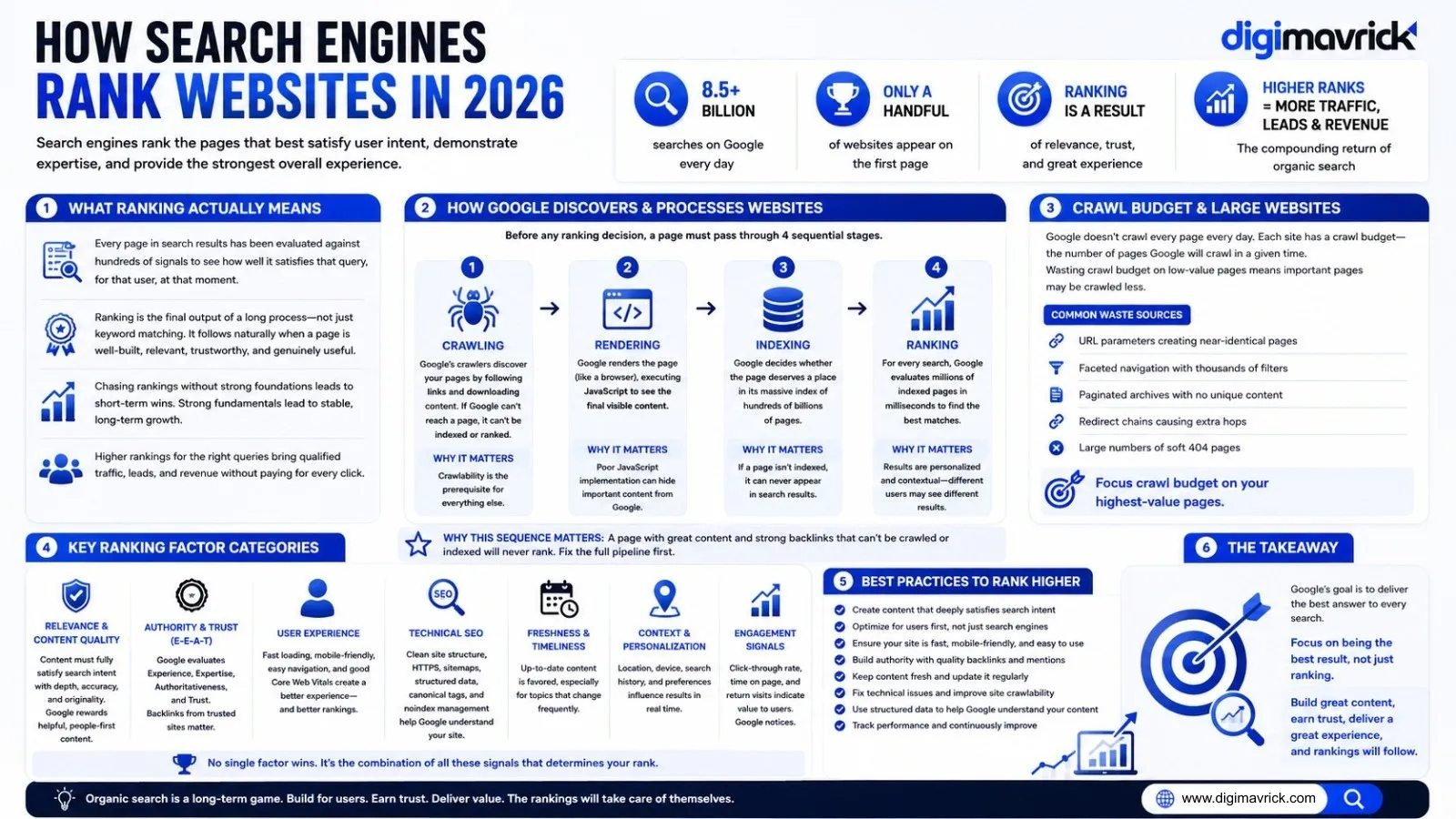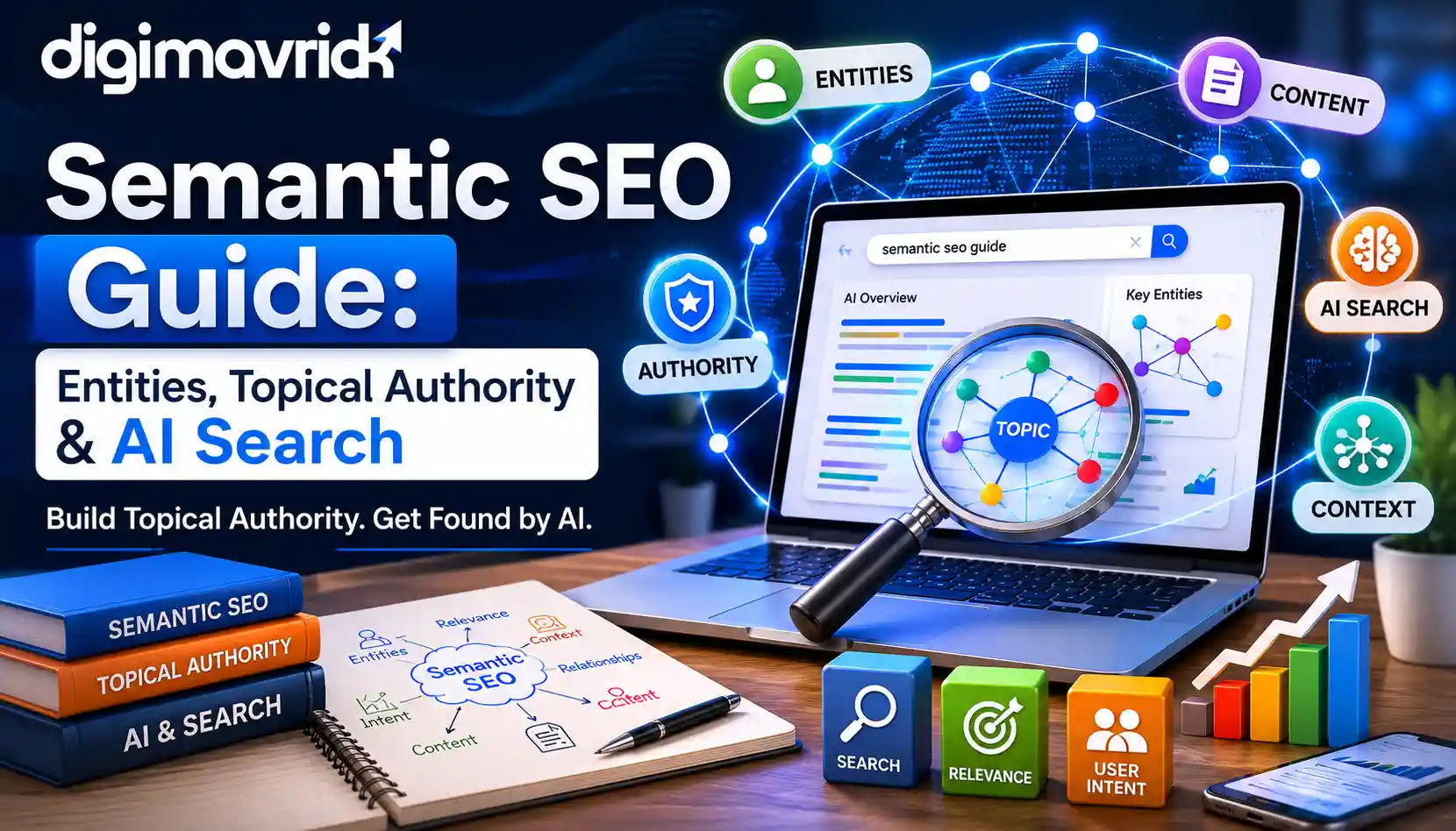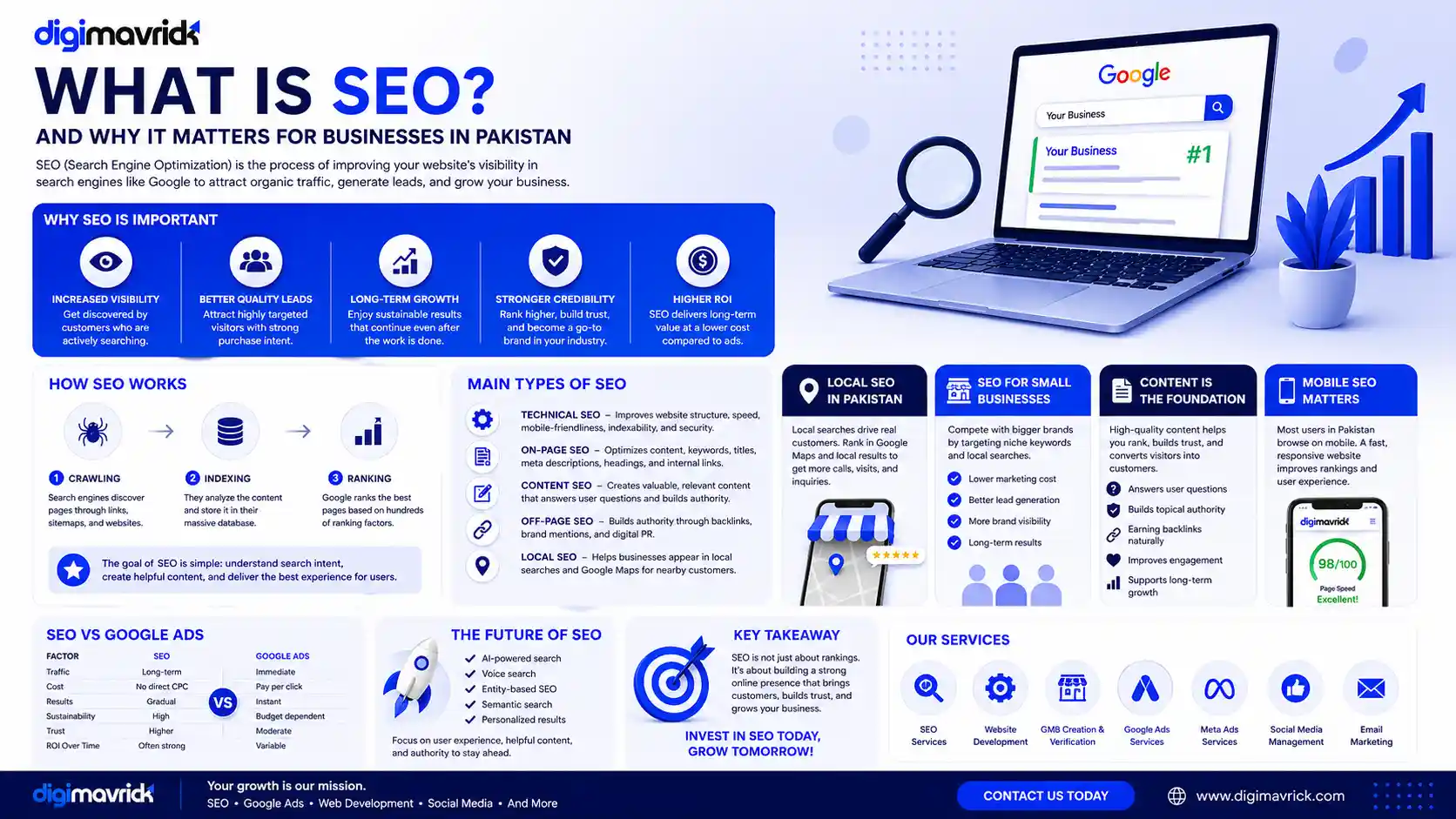
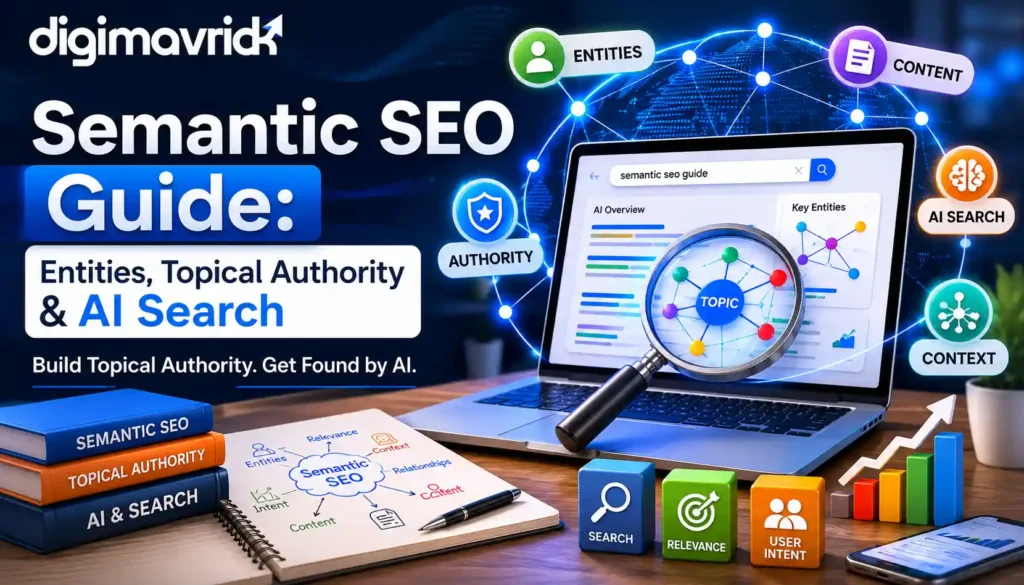
| Executive summary Search engines no longer rank pages because they contain the right keywords. They rank pages because they demonstrate the deepest, most trustworthy understanding of a topic. This guide explains exactly how that works, introduces the SCN Semantic Authority Framework as a practical implementation system, and shows you how to apply entity optimisation, topic clusters, structured data, and EEAT signals to build organic visibility that compounds over time and holds up in AI-driven search. |
What is Semantic SEO?
Semantic SEO is the discipline of optimising content around the full meaning of a topic rather than around individual keyword strings. It requires you to understand which entities relate to your subject, how those entities connect to each other, what users genuinely need when they search, and how to demonstrate your expertise on the complete topic ecosystem.
Traditional SEO asked: how many times does this keyword appear? Modern Semantic SEO asks: does this page comprehensively and credibly answer the topic it covers?
That shift is not cosmetic. It reflects a fundamental change in how search engines process information, and it has direct consequences for which pages rank, which sources get cited by AI systems, and which brands build durable authority.
Why Semantic SEO matters now
Two developments have accelerated the importance of semantic optimization.
AI-driven search retrieval
Google AI Overviews, ChatGPT Search, Perplexity, and Microsoft Copilot all retrieve information using semantic understanding rather than keyword matching. These systems evaluate entity relationships, information completeness, and topical authority to decide which sources to surface. Content that speaks only in keywords simply does not register in this environment.
Google’s quality evaluation frameworks
Google’s Search Quality Rater Guidelines place Experience, Expertise, Authoritativeness, and Trustworthiness at the centre of how human evaluators assess page quality. Semantically rich content, expert authorship, and comprehensive topic coverage are the practical expressions of those criteria.
| 65%+ of Google searches now return AI-driven features Pages with strong entity coverage and structured semantic signals are significantly more likely to appear in AI Overviews and featured snippets. Source: industry analysis, 2025. |
How search engines understand meaning
Modern search systems use a layered set of technologies to move from words on a page to an understanding of what a page actually means.
Natural Language Processing
Natural Language Processing allows search engines to identify topics, entities, relationships, sentiment, and intent from text. It enables Google to recognise that ‘how to improve website performance’ and ‘how to speed up my website’ carry identical intent even though the words differ.
The Knowledge Graph
Google’s Knowledge Graph maps billions of entities and their relationships. Every time you optimise for an entity rather than a keyword, you are working with the Knowledge Graph’s architecture. Examples of entity relationships include:
- Business provides a service
- Doctor specialises in a medical field
- Product belongs to a category
- City is located in a country
The Knowledge Graph allows Google to evaluate your content based on how well it fits within an established web of meaning, not just whether it contains the right phrases.
BERT and contextual language modelling
BERT (Bidirectional Encoder Representations from Transformers) enables Google to understand the meaning of words based on everything surrounding them in a sentence. This allows nuanced query interpretation, especially for conversational and long-tail searches.
MUM and multimodal understanding
The Multitask Unified Model processes information across text, images, and multiple languages simultaneously. This expands Google’s capacity to answer complex queries and compare information across formats, raising the bar for content that genuinely satisfies sophisticated search intent.
Entities: the foundation of modern search
An entity is any uniquely identifiable person, organisation, place, concept, product, or service. Entities are the building blocks of the Knowledge Graph and the primary lens through which modern search engines evaluate meaning.
The distinction between a keyword and an entity is not semantic wordplay. It is the difference between a string of characters and a specific, disambiguated identity with relationships, attributes, and a place in the Knowledge Graph.
| Signal type | Keyword | Entity |
|---|---|---|
| Identifies | A string of characters | A uniquely identifiable concept or thing |
| Ambiguity | High (Apple: fruit or company?) | None; context resolves identity |
| Machine understanding | Literal pattern matching | Semantic relationship mapping |
| Knowledge Graph eligible | No | Yes; entities connect across the KG |
| sameAs linking | Not applicable | Links entity to authoritative sources (Wikidata, etc.) |
Entity disambiguation
The term ‘Apple’ could refer to Apple Inc. or the fruit apple. Search engines resolve this ambiguity using contextual signals: the other entities on the page, the topic cluster the page belongs to, the internal links pointing to it, and the structured data describing it.
You accelerate disambiguation by:
- Using full entity names consistently. Write ‘Apple Inc.’ not just ‘Apple’ when discussing the technology company.
- Surrounding your primary entity with related entities. A page about Apple Inc. should naturally include references to Tim Cook, Cupertino, the App Store, and iOS.
- Implementing sameAs in your JSON-LD. Link your entity to its authoritative external source (Wikidata, Wikipedia, Companies House, etc.). This signals to Google that your on-page entity and the Knowledge Graph entity are the same thing.
Implementing entity optimisation with JSON-LD
Structured data in JSON-LD format is the most reliable way to make your entity signals machine-readable. Below is a complete JSON-LD implementation for an SEO consultancy, demonstrating Organisation schema with sameAs entity linking. For Example:
<script type="application/ld+json">
{
"@context": "https://schema.org",
"@type": "Organization",
 "@id": "https://digimavrick.com/#organization",
 "name": "digimavrick",
"url": "https://digimavrick.com",
"description": "SEO and digital marketing consultancy specialising in Semantic SEO, topical authority,and EEAT-led content strategy.",
"foundingDate": "2019",
 "address": {
"@type": "PostalAddress",
"addressLocality": "Lahore",
"addressCountry": "PK"  },
"sameAs": [
"https://www.wikidata.org/wiki/[your-entity id]",
"https://www.linkedin.com/company/",
"https://twitter.com/"
],
"knowsAbout":
[
"Semantic SEO",
"Entity Optimisation",
"Topical Authority",
"EEAT"  ]
}
</script>| Implementation note: Article and FAQ schema Every long-form editorial piece should also carry Article schema (linking to the author’s Person entity) and FAQPage schema for any question-and-answer sections. Article schema includes the ‘author’ property, which references a named Person entity with its own sameAs links to authoritative profiles. This is how you make EEAT signals machine-readable, not just visible to human readers. |
Semantic SEO vs. traditional SEO: a direct comparison
The following table captures the practical differences between keyword-led and semantic optimisation across eight dimensions that directly affect rankings, topical authority, and AI search visibility.
| Dimension | Traditional SEO | Semantic SEO |
|---|---|---|
| Primary focus | Exact-match keywords | Topics, entities, context, and intent |
| Ranking signal | Keyword frequency and density | Semantic depth and topical authority |
| Content unit | Individual keyword-targeted page | Interconnected topic cluster |
| Entity handling | Not considered | Core to every optimisation decision |
| AI search visibility | Low; keyword-only signals missed | High; entity and context signals surface content |
| Longevity | Vulnerable to algorithm changes | Resilient; meaning-based relevance holds |
| Internal linking | Typically ad hoc | Structured semantic pathways between clusters |
| EEAT alignment | Incidental | Built into topic depth and author signals |
Search intent: the purpose behind every query
Google’s primary objective is to satisfy user intent. Before you write a single word of content, you need to identify the dominant intent behind your target queries and align your content format, depth, and CTA accordingly.
There are four intent categories, each requiring a different content strategy response.
| Intent type | Example queries | Content strategy response |
|---|---|---|
| Informational | What is Semantic SEO / How do entities work | In-depth educational guides with FAQ schema |
| Navigational | Google Search Console / SCN Network | Brand pages, service landing pages |
| Commercial investigation | Best SEO agency / Top semantic SEO tools | Comparison content, case studies, proof points |
| Transactional | Hire SEO consultant / Book SEO audit | CTA-led landing pages with trust signals |
Most pages should satisfy a dominant intent while also addressing secondary questions. A page targeting ‘what is Semantic SEO’ (informational) may also serve commercial investigation intent by including a comparison table and a consultation CTA, as long as the primary content depth serves the informational user first.
Topical authority: how websites earn the right to rank
Topical authority is the accumulated credibility a website builds by consistently publishing comprehensive, expert-level content across a defined subject area. Search engines use topical authority as a proxy for real-world expertise.
A website that publishes one excellent article about SEO has demonstrated interest. A website that publishes interconnected, expert-led content covering every significant sub-topic of SEO has demonstrated authority. The difference is measurable in rankings and in AI citation rates.
| Our observation Websites with structured topic clusters consistently outperform single-page optimization efforts on competitive queries. The compounding effect of internal semantic linking, consistent entity coverage, and regular content freshness creates a ranking floor that isolated pages cannot reach. |
Topic clusters: the architectural expression of topical authority
A topic cluster organises content around a central theme with two layers.
- Pillar content. A comprehensive, authoritative piece covering the full topic at a high level. Example: ‘The complete guide to Digital Marketing.’
- Spoke content. Specialist articles covering each significant sub-topic in depth. Examples: Semantic SEO, Technical SEO, Local SEO, Content Marketing, Google Ads, Meta Ads, Conversion Rate Optimisation.
Internal links connect spoke content to the pillar and to each other, creating semantic pathways that signal the hierarchy and relevance of your content to search engines. These pathways are not decorative. They tell Google which entities and topics your site understands, at what depth, and in what relationship to each other.
Information gain: the ranking differentiator most sites ignore
Information gain refers to the degree to which a piece of content contributes something that does not already exist in the indexed web. Search engines increasingly reward information gain because it is the most reliable signal that a source provides genuine value rather than simply reorganising existing knowledge.
Information gain is the area where most content strategies fail, including many that correctly execute all other semantic SEO principles. If your content covers the right topics, uses the right entities, and targets the right intent, but says nothing that could not have been assembled from existing sources in ten minutes, it competes on authority signals alone.
Practical sources of information gain include:
- Original research. Surveys, data analysis, and proprietary studies that produce findings unavailable elsewhere.
- Documented case studies. Specific client outcomes with named metrics, timelines, and methodologies.
- Proprietary frameworks. Named methodologies that give practitioners a repeatable system (see the SCN Semantic Authority Framework below).
- Expert synthesis. Combining publicly available data in a way that produces a new insight or conclusion.
- First-hand experience. Tactical findings from direct implementation that differ from generic advice.
The SCN Semantic Authority Framework
The following seven-phase framework represents the implementation system we apply across all semantic SEO engagements at SCN Network. It sequences the foundational decisions in the order that produces the fastest compounding return.
| Phase | Action | Output |
|---|---|---|
| 1. Entity map | Identify primary, secondary, and supporting entities for the topic | Master entity list with disambiguation and sameAs sources |
| 2. Intent audit | Map every primary query to one of four intent categories | Content brief with intent-matched format and depth |
| 3. Cluster build | Create pillar content and supporting spoke articles for each theme | Linked topic cluster with internal semantic pathways |
| 4. Structured data | Implement Article, FAQ, and Organisation JSON-LD schema | Machine-readable entity and content signals for the Knowledge Graph |
| 5. EEAT layer | Add named authorship, credentials, citations, and review dates | Trust signals that satisfy both human evaluators and quality raters |
| 6. Information gain | Inject original data, proprietary frameworks, or documented case studies | Unique content signals that differentiate from competing sources |
| 7. Refresh cycle | Schedule quarterly content reviews against updated SERP and entity data | Sustained freshness signals and sustained topical authority |
Each phase builds on the previous one. Entity mapping informs intent auditing. Intent auditing shapes the cluster architecture. The cluster architecture determines which structured data you implement. EEAT and information gain layer on top to ensure that a technically sound content system also satisfies Google’s quality signals.
Internal linking as a semantic signal
Internal linking does three things in a semantic SEO strategy:
- It creates machine-readable pathways between related entities and topics, reinforcing the semantic relationships your content establishes.
- It distributes authority signals through the cluster, elevating spoke content by connecting it to the pillar’s established relevance.
- It signals topic hierarchy to search engines, clarifying which pages represent the most comprehensive treatment of a subject.
Anchor text selection matters. Use descriptive, entity-rich anchor text that accurately reflects the destination page’s topic. Avoid generic anchors like ‘click here’ or ‘learn more’, which strip out the semantic signal entirely.
Structured data and semantic understanding
Structured data translates on-page content into machine-readable signals that accelerate entity recognition and improve eligibility for enhanced search features. The most valuable schema types for a semantic SEO strategy are:
- Organisation / LocalBusiness. Establishes your business entity with sameAs links, knowsAbout properties, and address data.
- Article / BlogPosting. Identifies the content type, author entity, publication date, and modification date.
- FAQPage. Makes question-and-answer content eligible for rich results and increases AI citation likelihood.
- BreadcrumbList. Communicates content hierarchy and site structure to crawlers.
- Service. Describes your service offerings with explicit entity relationships to your organisation.
Structured data does not substitute for high-quality content. It amplifies the signals that high-quality content already contains. A thin page with comprehensive schema will not outrank a semantically rich page with minimal schema. Both layers working together is where the compounding effect occurs.
EEAT: the trust layer every semantic strategy requires
Google evaluates content quality through four lenses: Experience, Expertise, Authoritativeness, and Trustworthiness. Semantic SEO supports EEAT because comprehensive topic coverage demonstrates expertise. But EEAT also requires signals that content alone cannot provide.
Experience
Does the content reflect first-hand or direct experience with the subject? Document your own implementation, your own results, your own client outcomes. Generic advice, however accurate, does not satisfy the Experience criterion.
Expertise
Does the author have verifiable credentials or demonstrable skill in the subject area? Name your authors, link to their professional profiles, display their credentials, and ensure every piece of specialised content is attributable to a real, identifiable person.
Authoritativeness
Is your site recognised as an authority by other authoritative sources? Earn citations from industry publications, earn links from credible domains, and build your brand entity’s Knowledge Graph presence through consistent entity signals across the web.
Trustworthiness
Does the site demonstrate transparency, accuracy, and accountability? Publish clear contact information, display a privacy policy, cite your sources, correct errors publicly, and maintain a review schedule so content does not degrade over time.
| Practical EEAT implementation checklistNamed author byline on every article. Author bio with credentials and professional links. Article schema linking to the author’s Person entity with sameAs. Publication and last-reviewed dates displayed on the page. Cited sources with outbound links to authoritative references. Quarterly content review schedule. Transparent contact and about information. Organisation schema with sameAs links to Wikidata or Wikipedia. |
Semantic SEO and AI search visibility
AI-powered retrieval systems including Google AI Overviews, ChatGPT Search, Perplexity, and Microsoft Copilot retrieve and synthesise information using semantic understanding. They do not rank pages. They identify the most credible, most complete, most clearly structured sources on a topic and extract information from them.
Content optimised semantically is significantly more likely to be cited, summarised, and referenced by these systems because:
- Entity-rich content maps directly to Knowledge Graph relationships that AI systems use to verify and contextualise information.
- Comprehensive topic coverage provides the depth these systems need to answer complex, multi-part queries from a single source.
- FAQ schema and structured data make content accessible in the machine-readable format that AI retrieval prefers.
- EEAT signals serve as quality filters that AI systems use to decide which sources are trustworthy enough to cite.
Optimising for AI search is not a separate discipline from Semantic SEO. It is the same discipline applied with an awareness that your audience now includes both human searchers and automated retrieval systems.
Common semantic SEO mistakes that cost rankings
- Keyword stuffing without entity context. Repeating a keyword does not create semantic depth. Surrounding your primary entity with its related entities does.
- Thin content on competitive topics. A 600-word article on a topic with established authority competitors will not accumulate topical authority regardless of how well it is structured.
- Isolated pages without cluster architecture. Every page that exists without internal semantic connections is an orphan. It ranks alone or not at all.
- Anonymous content. Content without a named, credible author fails the Expertise and Experience dimensions of EEAT before a quality rater reads a single sentence.
- Missing structured data. Accurate on-page content without JSON-LD schema leaves entity signals unconfirmed and reduces eligibility for AI citation and rich results.
- No information gain. Accurate, well-structured content that simply reorganises existing knowledge competes on domain authority alone.
- Misaligned search intent. Publishing a transactionally framed page for an informational query, or vice versa, signals poor understanding of the user and the SERP.
Frequently asked questions
The following questions reflect real search queries around Semantic SEO. Add FAQPage schema to this section on publication.
Is Semantic SEO different from keyword SEO?
Yes. Keyword SEO focuses on matching search terms. Semantic SEO focuses on demonstrating comprehensive, credible understanding of a topic through entity coverage, contextual relationships, and EEAT signals. Keywords remain important, but they exist within a broader semantic framework that gives them meaning.
Does Semantic SEO replace keywords?
No. Keywords are still how users express their needs. Semantic SEO ensures that your content addresses the full meaning behind those keywords rather than just matching the surface string. The two work together.
What is topical authority and how do you measure it?
Topical authority is the credibility a website builds by publishing comprehensive, expert-led content across a complete subject area. Practical signals include the breadth of ranking keywords across a topic cluster, the volume of pages indexed for the subject, organic visibility trend over time, and the number of AI citations and featured snippets earned.
Why are entities more important than keywords?
Entities provide specificity and context that keywords cannot. A keyword is a string that may match many meanings. An entity is a uniquely identifiable thing with a position in the Knowledge Graph and a set of established relationships. Search engines can reason about entities in ways they cannot reason about keywords alone.
Does Semantic SEO help with AI search?
Yes, significantly. AI retrieval systems evaluate entity coverage, information completeness, topical authority, and EEAT signals when deciding which sources to surface and cite. Semantically optimised content is structurally aligned with how these systems retrieve and evaluate information.
How long does it take to build topical authority?
Meaningful topical authority typically requires three to six months of consistent, cluster-based content publication combined with technical SEO foundations. Domains with existing authority in adjacent areas may see acceleration. New domains with no topical history require sustained effort across a full cluster before authority signals compound.
Is Semantic SEO relevant for local businesses?
Yes. Local businesses benefit from entity optimisation (especially Organisation and LocalBusiness schema with sameAs links), topical authority within their service area and industry, and EEAT signals that establish credibility for high-intent, near-me searches. Google Business Profile optimisation works in direct conjunction with on-site semantic signals.
Final thoughts
Semantic SEO is not a tactic. It is the operating model for organic visibility in an era where search engines understand meaning, AI systems evaluate credibility, and users expect comprehensive answers from sources they can trust.
Businesses that build content around topics rather than keywords, establish their entities within the Knowledge Graph, demonstrate verifiable expertise, and inject genuine information gain into their content strategy will build the kind of topical authority that compounds over time and holds up through algorithm evolution.
The SCN Semantic Authority Framework exists to make that process systematic. Entity mapping, intent auditing, cluster architecture, structured data implementation, EEAT layering, information gain, and a regular refresh cycle are not seven independent tasks. They are seven phases of a single, compounding strategy.
The brands that execute this framework consistently are the ones that own their topics, dominate their SERPs, and get cited by the AI systems that are rapidly becoming the first stop in every search journey.
| Ready to build real topical authority? Our semantic SEO audits identify exactly where your entity coverage, topic cluster architecture, and EEAT signals are leaving rankings on the table. We deliver a prioritized, implementation-ready roadmap, not a generic report. Request your free 20-minute strategy call at here |